January 8, 2025 · 8 min read · Maria Delgado, EPA 608 Universal Certified
Furnace Won't Ignite? A Safe 6-Step DIY Checklist
Before settling in for a long wait with no heat, walk through these six safe checks. They resolve roughly 40% of no-heat calls before a tech is even needed.
Furnace Won't Ignite? A Safe 6-Step DIY Checklist Guide
It's 20°F outside. The furnace clicks, hesitates, clicks again, and refuses to fire. Inside the house is already two degrees cooler than ten minutes ago. Before you settle in for a multi-hour wait, run the six safe checks below. They resolve roughly four out of every ten no-heat calls in our dispatch logs — fixes any homeowner can complete with no tools, no risk, and no service-call fee.
1. Replace the thermostat batteries
Battery-powered thermostats are by far the most common culprit, and this is the most over-looked fix in residential HVAC. Even if the display looks bright and normal, a weakening battery may not have enough voltage to send the call-for-heat signal to the furnace's control board. Pop the thermostat off the wall and check for a battery compartment — most use two AA alkalines. Replace them with fresh batteries, not the ones you found in the junk drawer last summer. While the cover is off, check the date on the thermostat itself; anything over 12 years old is at the end of its life and may be sending phantom calls or none at all.
2. Verify thermostat mode and setpoint
If anyone in the house has touched the thermostat recently — a houseguest, a child, the cleaning service — verify three settings. Mode must read HEAT (not COOL, not OFF, not EMERGENCY HEAT unless you actually want auxiliary strips engaged). Setpoint must be at least two degrees above the current room temperature. Fan should be AUTO; on ON the blower runs constantly and the system never lets the heat exchanger warm up.
Smart thermostat traps
Smart thermostats (Nest, ecobee, Honeywell T-series) introduce their own failure modes. Check that Eco mode isn't holding the temperature down, that geofencing hasn't put the house into "Away" because everyone's phones are in airplane mode, and that an Alexa or Google Home routine hasn't switched it OFF.
3. Check the breaker panel
Open your electrical panel. Find the breaker labeled "Furnace," "Air Handler," or "HVAC." A tripped breaker sits in the middle position — not fully off. Push it firmly OFF, wait ten seconds, then snap it back to ON. If the furnace fires within a minute, you're done. If the breaker trips again immediately, stop. A breaker that won't hold means there's a short — possibly in the inducer motor, control board, or transformer. That's an immediate service call.
4. Reseat the furnace door safety switch
Every modern furnace has a small black plastic interlock switch on the front access panel. Its job is to cut all power to the gas valve and igniter whenever the panel is open, so a tech can never accidentally start the burners while their face is in the cabinet. If your panel isn't fully seated — even by a quarter inch — the switch won't engage and the furnace won't run. Open the panel, press the switch with your finger to confirm a crisp click, then firmly reinstall the panel until you hear the latches catch. We see this issue constantly after homeowners change their own filter, especially with side-mount filter doors.
5. Replace a severely clogged filter
A filter that hasn't been changed in six months will trip the furnace's high-limit safety switch. Here's the sequence: restricted airflow lets heat build up in the heat exchanger, the high-limit sensor sees an unsafe temperature, the controller cuts the gas, and the system locks out for two hours before retrying. Replace the filter with the same size and MERV rating. Then reset the furnace by cycling its breaker off for 60 seconds and back on.
6. Confirm gas is on
If you have natural gas, walk to your meter. The main valve should be parallel to the pipe (open). At the furnace itself, find the small black valve on the gas line about a foot from the cabinet — its handle should also be parallel to the pipe. If anyone turned anything off for any reason (plumbing work, a remodel, an appliance install), restore it. For propane homes, check that the tank gauge isn't reading below 20% — propane regulators struggle below that level in cold weather.
What it usually is when none of those work
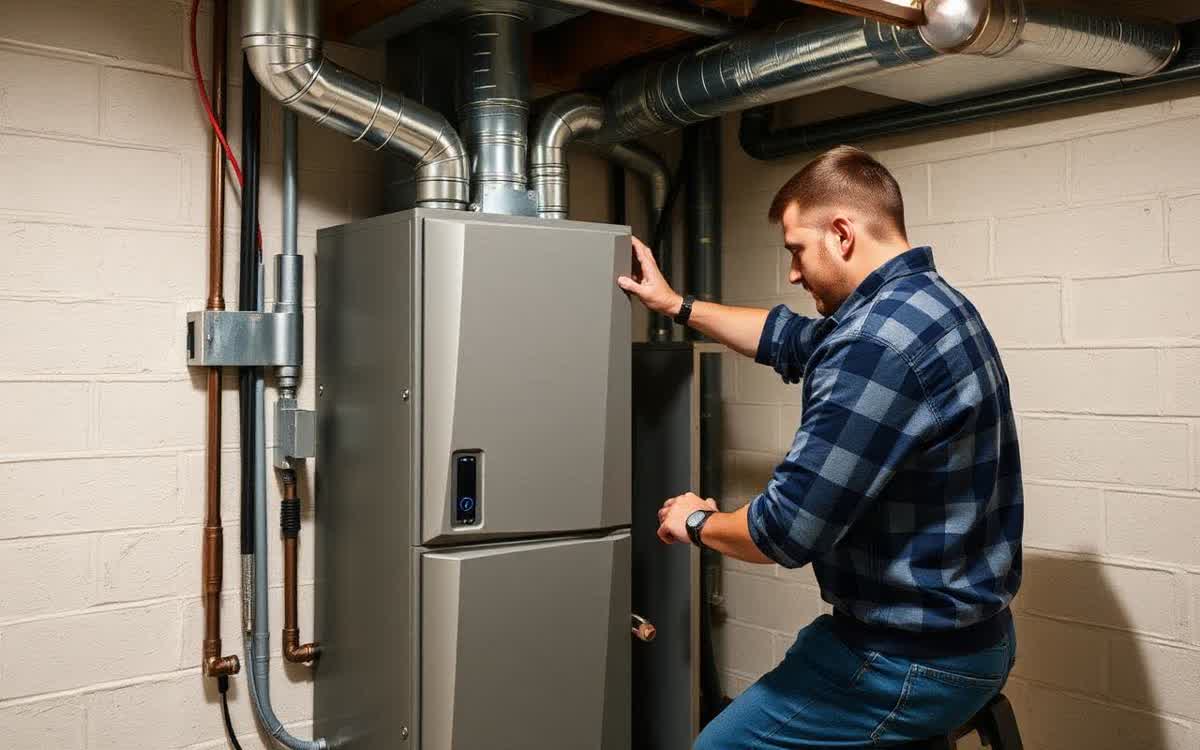
If you've checked all six and the furnace still won't fire, you're into territory that requires a multimeter, a manometer, and a flame-sensor cleaning brush. The usual suspects in this bucket:
- Dirty flame sensor (the #1 service call we run in January) — $129 to clean and test
- Cracked hot-surface igniter — $235–$385 part-and-labor
- Failed pressure switch — usually $245–$345
- Cracked inducer motor housing — $400–$650
- Failed control board — $450–$700 depending on brand
Stay safe while you wait
If the house is dropping below 60°F and a tech isn't arriving for several hours, take a few precautions. Open the cabinet under every kitchen and bathroom sink to expose pipes to warmer interior air. Set faucets on exterior walls to a slow drip — moving water resists freezing. Close interior doors of rooms you're not using to concentrate residual heat into your living space. If you have a wood-burning fireplace or wood stove, use it.
What not to do: never use a gas oven, charcoal grill, propane patio heater, or unvented kerosene heater to warm the home. Carbon monoxide poisoning kills more people in cold-snap weeks than the cold itself. If you don't have a battery-backed CO detector, that's the single most important $30 you'll spend this winter.
When you're ready for a tech, Comfort Pro HVAC answers (626) 618-8360 24 hours a day with a live dispatcher. We'll have someone heading to you before you finish making coffee, and the flat-rate quote is on the table before any work begins.
Talk to an HVAC expert about Furnace Won't Ignite? A Safe 6-Step DIY
Live dispatcher 24/7. Same flat-rate pricing day or night.